What Does an EMR Cost in BC? A Complete Breakdown for Clinics
Last Updated
Author
Team Aeon
If you’re looking for EMR costs in BC, here’s the direct answer:
Most clinics in British Columbia pay a monthly subscription fee per provider, plus potential onboarding, training, and migration costs. Total cost depends on clinic size, hosting model (cloud vs server-based), support structure, and whether you’re implementing a new system or switching from an existing one.
But the true cost of an EMR isn’t just the subscription price. It includes:
Setup and migration fees
Hardware or IT infrastructure (if server-based)
Ongoing maintenance
Productivity impact
Administrative inefficiency over time
This guide breaks down EMR pricing in Canada in structured categories — so you can evaluate total cost of ownership, not just monthly fees.
TL;DR
• Most clinics in BC pay per-provider monthly subscriptions plus onboarding fees.
• Total cost includes migration, infrastructure, and efficiency impact.
• Switching EMR cost is often underestimated.
• The lowest subscription price is not always the lowest long-term cost.
• Evaluate 3–5 year total cost of ownership, not just monthly fees.
Direct Answer: How Much Does an EMR Cost in BC?
There is no single number that defines EMR cost in BC.
Most modern cloud-based EMRs in Canada use:
Per-provider monthly subscriptions
Tiered feature plans
Optional add-ons for advanced tools
Legacy server-based EMRs may involve:
Larger upfront licensing fees
Hardware purchases
Ongoing IT support contracts
If you’re opening a new clinic, costs will look different than if you’re calculating the switching EMR cost from an existing system.
The key takeaway: evaluate both visible pricing and multi-year operational impact before deciding.
In BC, clinics must also consider MSP billing workflows and provincial privacy requirements when evaluating long-term cost implications.
For broader context on evaluating vendors, see our complete guide to choosing an EMR in BC.
Subscription Pricing Models
Most EMR pricing in Canada follows one of these structures:
1. Per-Provider Monthly Subscription
The most common model for cloud EMRs.
Fixed fee per physician per month
Often includes updates and basic support
Scales as your clinic grows
This model offers predictable operating expenses and lower upfront investment.
2. Per-User Licensing
Some systems charge based on total user accounts (physicians + MOAs).
This may reduce costs for solo clinics but increase costs in larger team-based environments.
3. Tiered Feature Plans
Vendors may offer:
Base clinical documentation
Premium reporting tools
Advanced automation features
Integrated AI tools
Always confirm what is included in the base price.
4. Hybrid or Legacy Licensing
Older legacy EMR Canada systems may involve:
One-time license purchase
Annual maintenance fees
Separate update contracts
These models shift more cost to upfront capital expenditure.
One-Time Setup Fees
Beyond monthly subscription cost, most clinics encounter onboarding expenses.
Common Setup Cost Categories
Data migration from previous EMR
Template configuration
Workflow customization
Initial training sessions
Implementation support
Some vendors bundle onboarding into subscription pricing. Others charge separate professional service fees.
If you’re starting fresh (no prior EMR), migration costs may be minimal — but workflow setup still requires time.
Migration & Switching Costs
The switching EMR cost in BC is often underestimated.
When transitioning from one system to another, consider:
1. Data Extraction Fees
Your current vendor may charge:
Data export fees
Chart format conversion costs
Archive access fees
Always clarify this early.
2. Data Cleanup & Mapping
Not all historical data transfers cleanly.
You may need:
Template reconfiguration
Problem list reconciliation
Billing code review
3. Parallel System Period
Clinics often maintain:
Temporary access to the old system
Dual logins during transition
Gradual patient migration
This overlap increases short-term costs.
4. Temporary Productivity Dip
Expect:
Slower charting during initial weeks
Extra time for staff adaptation
Increased support calls
While temporary, this dip has financial implications.
Not all vendors structure onboarding the same way. Some modern EMRs now include migration and training within their subscription pricing — a signal that the vendor views onboarding as a partnership, not a transaction. Understanding how switching costs are handled can significantly affect total investment and long-term confidence in your decision.
Hidden Operational Costs
The largest EMR cost is often invisible.
1. Time Per Patient
If an EMR adds:
2 extra minutes per visit
3 extra clicks per workflow
Manual reconciliation steps
That compounds across thousands of visits per year.
Small inefficiencies scale quickly in primary care.
2. Administrative Overhead
Inefficient systems increase:
MOA workload
Billing correction time
Task duplication
Missed follow-ups
Operational drag has real financial impact.
3. IT Maintenance (Server-Based Systems)
With a server-based EMR, clinics may face:
Hardware replacement cycles
Network security management
Backup testing
Emergency troubleshooting
These costs rarely appear in the initial quote.
For a deeper comparison of infrastructure models, see our breakdown of cloud-based vs legacy EMRs.
4. Downtime Risk
System outages affect:
Clinic scheduling
Documentation
Billing
Patient communication
Redundancy infrastructure matters.
Cost vs Efficiency Tradeoff
The lowest monthly subscription is not always the lowest total cost.
A slightly higher EMR subscription cost may deliver:
Faster documentation
Reduced billing errors
Lower staff frustration
Better panel management efficiency
In other words:
Cost must be evaluated alongside workflow performance.
An EMR that saves each physician 20 minutes per day may generate more long-term value than one that costs slightly less but slows down operations.
ROI Framework for Clinics
Instead of asking “What does this EMR cost?” ask:
“What does this EMR enable?”
Step 1: Estimate Time Savings
Minutes saved per patient
Reduced after-hours charting
Decreased billing rework
Even small time savings per patient can compound significantly across a full primary care panel.
Step 2: Estimate Administrative Efficiency
Fewer follow-up errors
Improved task routing
Faster referral management
Step 3: Factor in IT Overhead
Server replacement cycles
Support contracts
Maintenance downtime
Step 4: Calculate Multi-Year Impact
Look at a 3–5 year horizon:
Subscription fees
Infrastructure costs
Productivity gains or losses
This reframes the conversation from cost to value.
Structured Cost Categories Summary
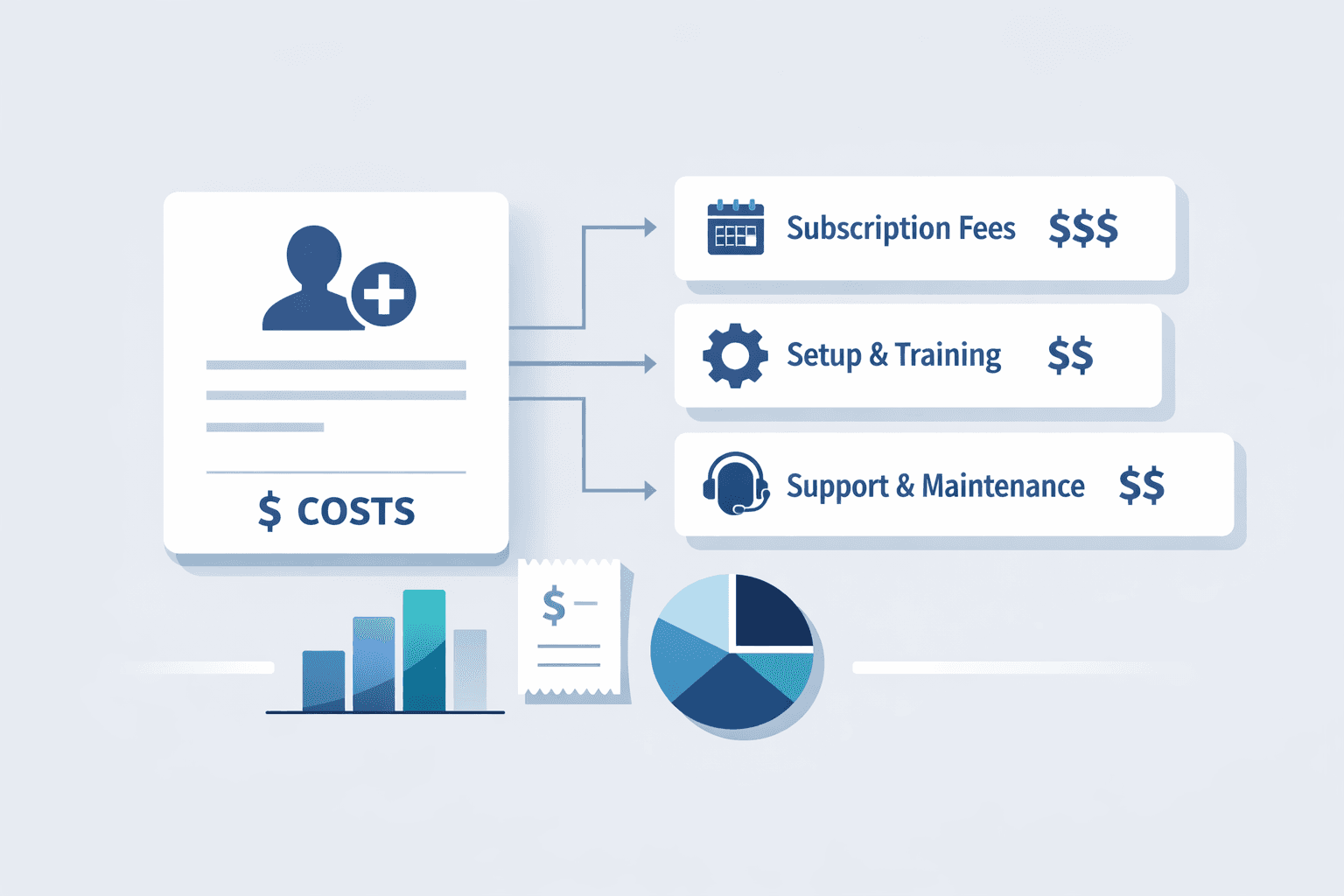
When evaluating EMR pricing in Canada, organize costs into five categories:
Subscription Fees – Monthly per-provider or per-user charges
Implementation & Setup – Onboarding, configuration, training
Migration Costs – Data extraction, overlap period, productivity dip
Infrastructure Costs – Servers, IT support, backups (if applicable)
Operational Efficiency Impact – Time saved or lost per day
Total cost of ownership includes all five.
FAQ: EMR Cost in BC
What is the average EMR cost in BC?
There is no fixed average. Costs vary based on clinic size, pricing model, and infrastructure needs. Most modern systems use per-provider monthly subscriptions plus onboarding fees. The true cost depends on both pricing and efficiency impact.
Is a cloud EMR cheaper than a server-based EMR?
Often, yes — especially when factoring in IT maintenance and hardware replacement. However, pricing structures vary. Always compare total cost of ownership, not just subscription fees.
How much does it cost to switch EMRs in BC?
Switching EMR cost includes data extraction, migration services, potential vendor exit fees, and temporary productivity loss. Costs vary widely depending on data volume and clinic size.
Are EMR subscription costs tax deductible?
In many cases, EMR subscription costs are treated as operating expenses. However, clinics should consult a professional accountant for specific tax guidance.
Key Takeaways
EMR cost in BC includes more than monthly subscription fees.
Evaluate setup, migration, infrastructure, and operational efficiency.
Switching EMR cost can be significant but manageable with planning.
Cloud-based pricing often reduces IT overhead.
The lowest price does not always equal the best long-term value.
When evaluating EMR pricing in Canada, think beyond the invoice.
The right system should reduce friction, improve efficiency, and support your clinic’s growth — not quietly increase administrative burden over time.
Over a five-year horizon, those differences compound far more than most subscription price comparisons suggest.