Why EMR Workflows Fail: The Hidden Problem of Follow-Through in Patient Care
Last Updated
Author
Team Aeon
It doesn’t usually feel like something is missing.
It feels like things are… mostly handled.
You saw the patient. You ordered the test. You sent the referral. You left yourself a note. You moved on to the next chart.
From the outside—and often from inside your EMR—that work looks done.
But later, something pulls at you.
Did that result ever come back?
Did the referral actually go through?
Was that follow-up booked, or just mentioned?
This isn't a workflow problem.
It's a follow-through problem.
Work that looks done vs. work that is done
Most clinic work doesn’t fail in obvious ways.
It fails quietly, in the space between steps.
A lab is ordered, but no one notices it never got results.
A referral is sent, but no one tracks whether it was received.
A follow-up is intended, but not concretely scheduled or surfaced again.
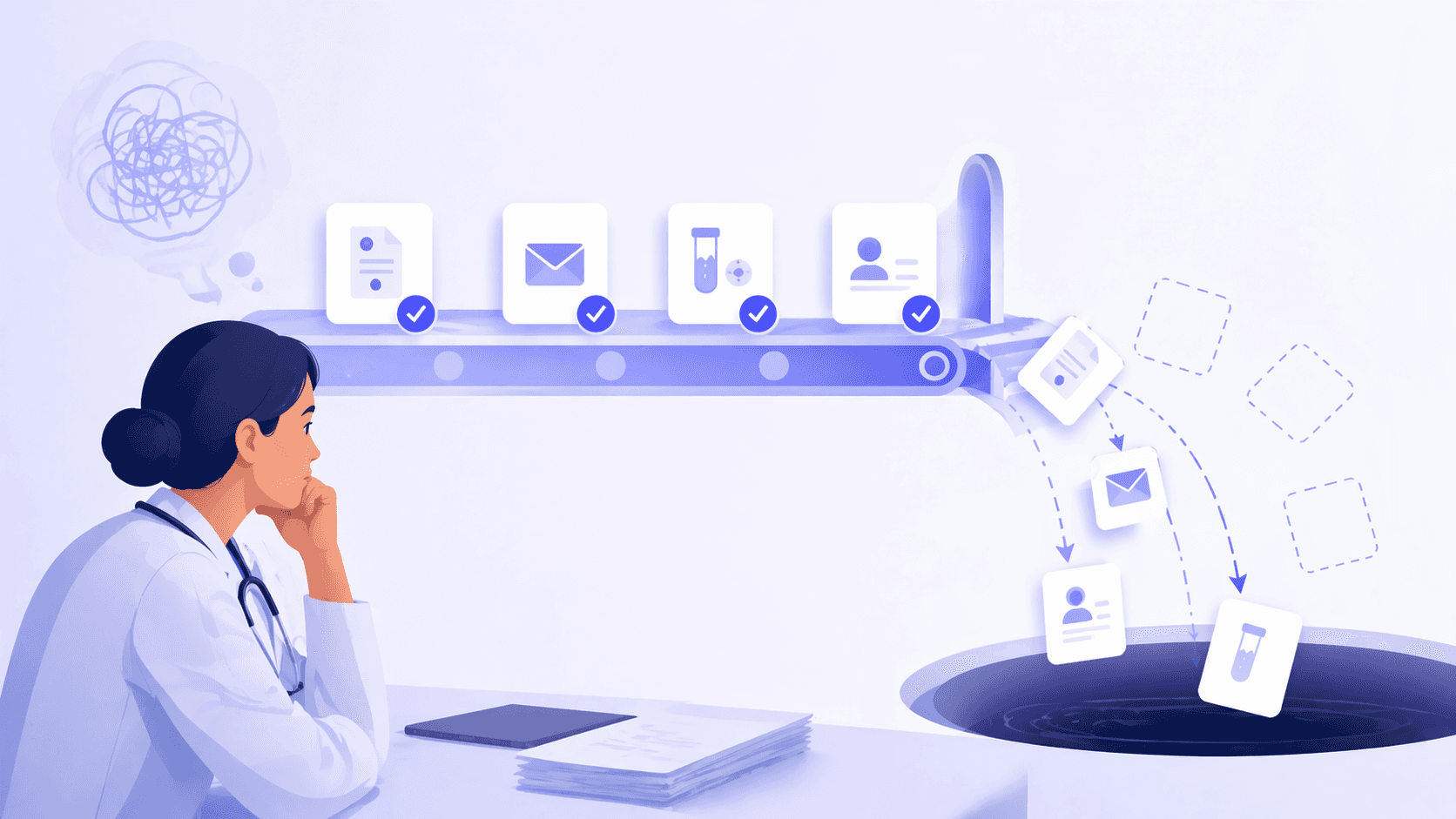
Each individual action is completed. Each box is checked.
But the loop isn’t closed.
And because the system registers those steps as “done,” it creates a subtle kind of confidence that isn’t entirely real.
The chart moves on. The day moves on.
The work, technically, does not.
The fragmentation you’ve learned to manage
In most clinics, patient work is scattered across:
Inbox messages
Lab results
Consult notes
Tasks and reminders
Paper faxes still finding their way into digital systems
None of these are inherently broken.
But they are not connected in a way that guarantees follow-through.
So the responsibility shifts—quietly but completely—onto you.
You become the system that holds it all together.
You remember which patients need chasing.
You keep a mental list of loose ends.
You double-check things not because the system failed, but because you don’t fully trust that it won’t.
Over time, this stops feeling like a flaw.
It just feels like part of the job.
The mental load no one names directly
People talk about burnout in terms of hours, volume, documentation.
But there’s a different kind of weight that’s harder to describe.
It’s the low-level, persistent question: What am I forgetting?
Not because you’re disorganized.
But because the system doesn’t reliably confirm that work has reached an actual endpoint.
So your brain stays open on everything.
Every referral is a maybe.
Every pending result is a question mark.
Every follow-up is something you might need to remember later.
This is not inefficiency.
This is unfinished work that has been normalized.
Why “workflow optimization” misses the point
Most conversations about EMRs focus on speed.
Fewer clicks. Faster navigation. Smoother workflows.
Those things matter. But they’re solving a surface problem.
You can move through a workflow quickly and still leave behind a trail of unclosed loops.
In fact, faster systems can make this worse—because they make incomplete work feel even more complete.
The real issue isn’t how efficiently you move through tasks.
It’s whether those tasks reliably reach a point of closure.
What current systems quietly assume
Most EMRs are built around events:
A visit. A note. A result. A task.
Once the event is recorded or acknowledged, the system considers that piece of work addressed.
But patient care doesn’t work that way.
Care is longitudinal. It depends on follow-through across time.
A result isn’t done when it’s filed.
A referral isn’t done when it’s sent.
A plan isn’t done when it’s written.
They’re only done when the loop is closed.
And most systems don’t actually track that.
So they leave you to do it.
The reframe: from workflow to closure
If you step back, the issue becomes clearer.
The problem isn’t that your workflow is inefficient.
It’s that your system doesn’t reliably tell you:
what is still open
what is at risk of being missed
what has actually reached completion
So you compensate.
You build personal workarounds.
You rely on memory.
You create redundancy where you can.
Not because you prefer it that way—but because it’s the only way to ensure patient work doesn’t slip through.
This is what “good workflow” has come to mean.
Managing around a lack of closure.
What better systems would take seriously
A different kind of system wouldn’t start with speed.
It would start with responsibility.
It would assume that:
Every piece of patient work needs a clear endpoint
That endpoint should be visible, trackable, and verifiable
The system—not the physician—should hold that continuity
Not perfectly. Not magically.
But reliably enough that you don’t have to carry everything yourself.
Because the goal isn’t to move faster through work.
It’s to be able to trust that the work is actually done.
Why this has been easy to accept
Part of what makes this problem hard to see is how gradually it becomes normal.
You adapt to the gaps.
You build habits around them.
You stop expecting the system to do more.
And because most tools operate the same way, it doesn’t feel like something is missing.
It just feels like medicine.
But the background tension never fully goes away.
Because somewhere underneath, you know the difference between something being recorded…
…and something being resolved.
Most clinics aren’t struggling because they’re inefficient.
They’re struggling because too much patient work exists in an in-between state—handled, but not finished.
And as long as systems continue to treat those two things as the same, that quiet uncertainty will remain part of the job.
It doesn’t have to be.