“Patient-Centered Care” Shouldn’t Mean Clinician-Centered Chaos
Last Updated
Author
Team Aeon
If you’ve worked in Canadian primary care for more than… let’s say seven minutes, you’ve probably noticed that “patient-centered care” has slowly drifted away from its original meaning.
Somewhere between the glossy policy PDFs, the accreditation standards, and the 47th startup promising to “reimagine the healthcare journey,” the idea quietly morphed from care designed around patients’ needs into care that pretends to be designed around patients’ needs while actually piling more work onto clinicians.
Which is impressive, honestly. That level of rhetorical gymnastics should qualify for CME credits.
Because here’s what “patient-centered care” often looks like today:
Shorter appointment slots
Larger panels
More portals
More billing codes
More “quick forms” that are decidedly not quick
More inbox messages (always marked “high priority”)
More documentation requirements to prove you’re doing the job you’re already doing
And of course, the classic: “Do more with less… but also do it faster… and smile.”
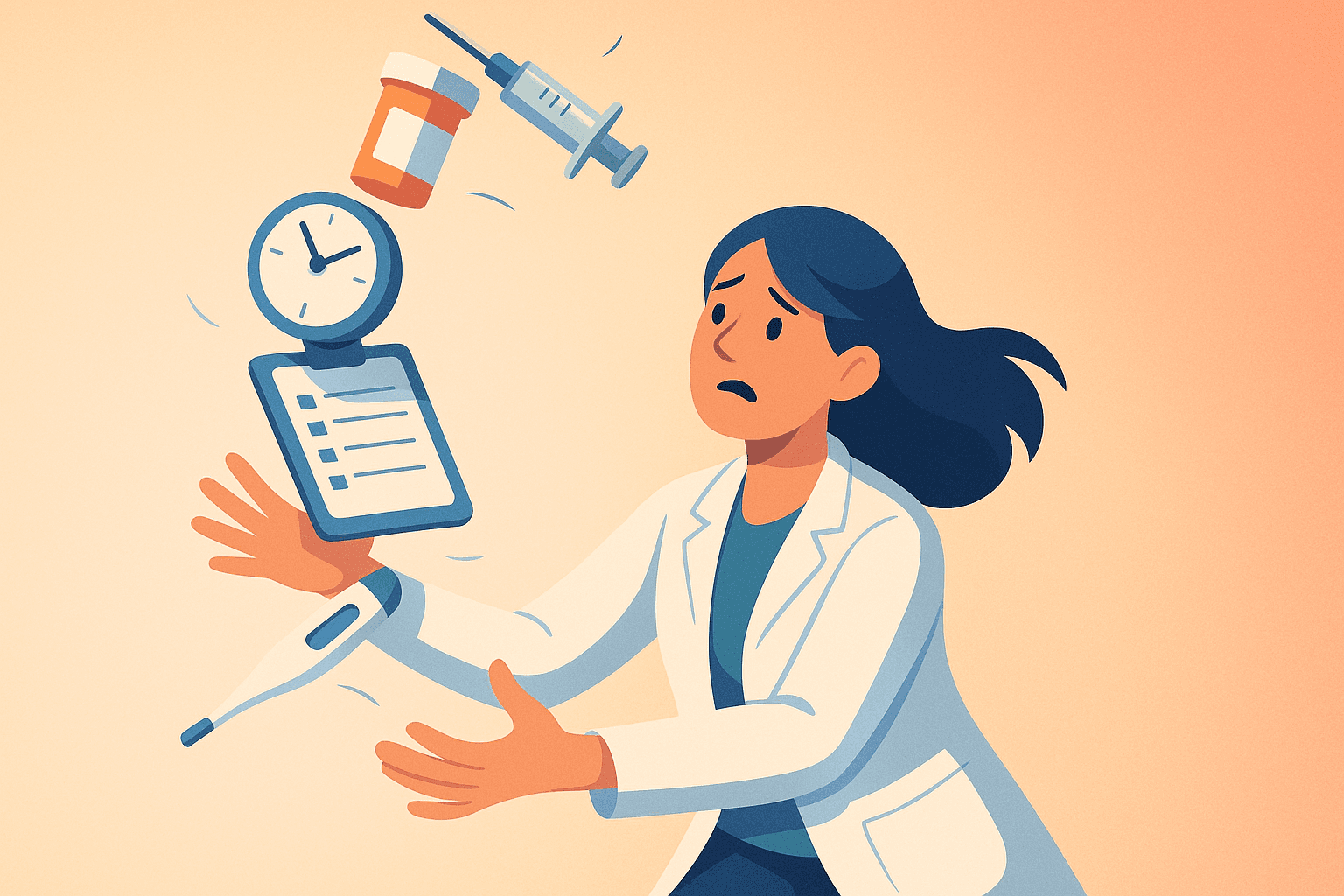
Somewhere along the line, what should have been a philosophy of compassion turned into a permission slip for the system to lean—very heavily—on the people actually doing the caregiving.
And yes, while the exam-table paper is still too loud, that’s not even the top three problems anymore.
The Irony of “Convenience”
The industry loves to brag about convenience: online booking, digital check-ins, virtual visits, prescription refills in a click.
These things are convenient—for patients.
But every convenience for one person has to land somewhere. And lately, it lands squarely in the clinician’s lap.
Digital booking? Great—until patients start creatively reinterpreting appointment types.
Online messaging? Fantastic—until your inbox becomes Narnia (a mysterious realm where messages disappear until suddenly they don’t).
Patient portals? Helpful—until every lab, every consult, and every “just checking…” generates a notification.
We’re not saying patients shouldn’t have access to these tools. They absolutely should. But the system rarely asks the complementary question:
What’s the cost to clinician time, focus, and sanity?
If the answer is “everything,” then no amount of “patient-centeredness” can compensate for the burnout it creates.
Because burned-out clinicians don’t deliver great care. They just survive it.
And that’s exactly why, at Aeon, we’re building tools that don’t hide new chores behind shiny interfaces. If something looks simple on the patient side, it shouldn’t become a labyrinth on the provider side.
The Invisible Load Nobody Talks About
There’s the clinical work—the thing you trained a decade for—and then there’s the other work.
The stuff that creeps in through portals and EMRs and bureaucratic rabbit holes.
The “can you fill out this form by end of day?”
The “quick message” that requires six chart reviews and a callback.
The “urgent” note from a specialist that raises more questions than it answers.
It’s not dramatic. It’s not headline-grabbing. But it’s constant.
And constant things drain humans, even really resilient ones.
Every small administrative task might seem harmless in isolation.
But together? They form a kind of digital Doritos bag—a thing that should be simple but is somehow unnecessarily loud, messy, and crumbs get everywhere.
And clinicians are the ones left sweeping it all up.
One of our north stars at Aeon is reducing this invisible load wherever it hides. If a task needs to exist, it should take seconds—not minutes. And if it doesn’t need to exist? Out it goes.
Where the System Gets It Backwards
Too often, improving “patient experience” means bolting shiny new expectations onto clinicians without removing anything else. Imagine if restaurants worked this way:
“Guests will now order through six platforms, customize every dish with unlimited modifiers, and message the kitchen directly.
Also, chefs must still prep, cook, and plate everything with zero extra time or staffing.
This is our new ‘guest-centered dining model.’”
Ridiculous, right?
Yet somehow this passes for innovation in healthcare.
We think the opposite approach works better: reduce friction for clinicians first, and patient experience gets better automatically. Supported clinicians have more time, more headspace, and more energy to care. The math is not complicated.
What a More Humane Model Could Look Like
Here’s the radical idea (brace yourself):
Patient-centered care and clinician-centered care are not opposites.
They’re the same thing.
If you want patients to feel cared for, the people caring for them must also feel supported.
A more balanced model could look like this:
1. Tools that reduce complexity—not shift it.
Technology shouldn’t be a digital middleman that adds more steps.
It should make essential tasks faster, clearer, and lighter—especially the boring stuff.
This is the backbone of Aeon’s design philosophy: no extra clicks, no extra clutter.
2. Workflows designed around actual clinical reality.
Not theory. Not wishful thinking.
Real-world practice: the interruptions, the multitasking, the cognitive load, the unexpected curveballs.
We build with clinicians, not around them.
3. Expectations that match capacity.
More inboxes? Then fewer documentation requirements.
More patient messages? Then protected time to handle them.
More “convenience features”? Then support to manage the consequences.
Technology should restore balance—not tilt it further.
4. Systems that centre humans on both sides of the exam room.
Patients deserve a seamless, compassionate experience.
Clinicians deserve the same.
One does not require sacrificing the other.
In fact, they rise together.
Why This Matters (Actually Matters)
Every time we talk with clinicians, we hear variations of the same theme:
“I want to practice medicine, not be a human router.”
“I spend more time documenting care than delivering it.”
“I love my patients, but the system makes it so hard to show it.”
Nobody went into medicine to be a cog in a paperwork machine.
And patients don’t want their doctors stressed, rushed, or drowning in admin tasks while trying to diagnose them.
When clinicians have space to think, breathe, and care—it shows.
And the ripple effects are enormous: better outcomes, better healing, better relationships, better everything.
This is the future we’re working toward: one where the system actually supports the people who keep it running.
The Optimistic Part (Because We Always End With One)
The good news?
We can absolutely fix this.
Not overnight. Not with another portal or a new “must-use” form.
But with tools and systems that genuinely lighten the load instead of shifting it.
With technology that treats clinicians as humans deserving of ease, not as infinite wells of time.
With workflows that reflect reality, not wishful thinking.
With a future where “patient-centered care” actually means what it was supposed to mean all along: care that respects the needs of everyone in the room.
We’re building toward that future every day.
Because clinicians deserve better—and patients deserve clinicians who aren’t running on fumes.
And honestly?
The whole system runs better when the people holding it up aren’t exhausted.
Here’s to a healthcare world that supports the people who support all of us.
We’re working on it—one thoughtful workflow, one reduced click, one lighter day at a time.